On a California property tax bill, below the assessed value and the one percent general levy, there's a line for voter-approved debt. It's usually small — a few hundred dollars, a rounding error next to the mortgage. That line is a municipal bond payment. The county collects it parcel by parcel, holds it in a fund it isn't permitted to spend on anything else, and passes it to a paying agent, who forwards it to whoever owns the bonds. That's the entire mechanism. There's no reserve behind it and no revenue stream underneath it — no toll booth, no water meter, no airport gate. Just parcels, and the assessed value sitting on them, and owners who send a check twice a year.
So the credit question on a municipal bond like this was never really about the issuer. It was always about what the land is worth.
What the pledge actually covers
The phrase in the offering document is full faith and credit, which sounds like a statement about character. It's narrower than that. The issuer is pledging its authority to levy, and to keep levying, until the last payment clears.
But taxing power is not the same as a tax base. A pledge to levy is only worth what there is to levy on — assessed value, and people still willing to own property and pay tax on it. Not every municipal bond works this way: revenue bonds are repaid from what a toll road or an airport or a water system actually collects. Where the tax base is the security, the security is land — and the people who stay on it.
Which is why climate risk doesn't stop at the borrower. It runs through the assessment, through the tax roll, and into the bond. A hazard severe enough to move people doesn't only damage property — it thins the roll that repays the debt.
Almost nobody is charging for it
In 2022 Intercontinental Exchange examined roughly 800,000 municipal bonds and found no sign that physical climate risk was reflected in what the market paid. Ratings agencies, ICE wrote in the same report, "don't bake climate risk explicitly into credit profiles of issuers … yet." SIFMA put the whole municipal market at $4.5 trillion as of early 2026.
And the tax base is already moving. ICE found climate risk tracking with slower property appreciation and slower population growth — which are, between them, the two ingredients of a tax roll.
Miami builds a wall and taxes the houses behind it
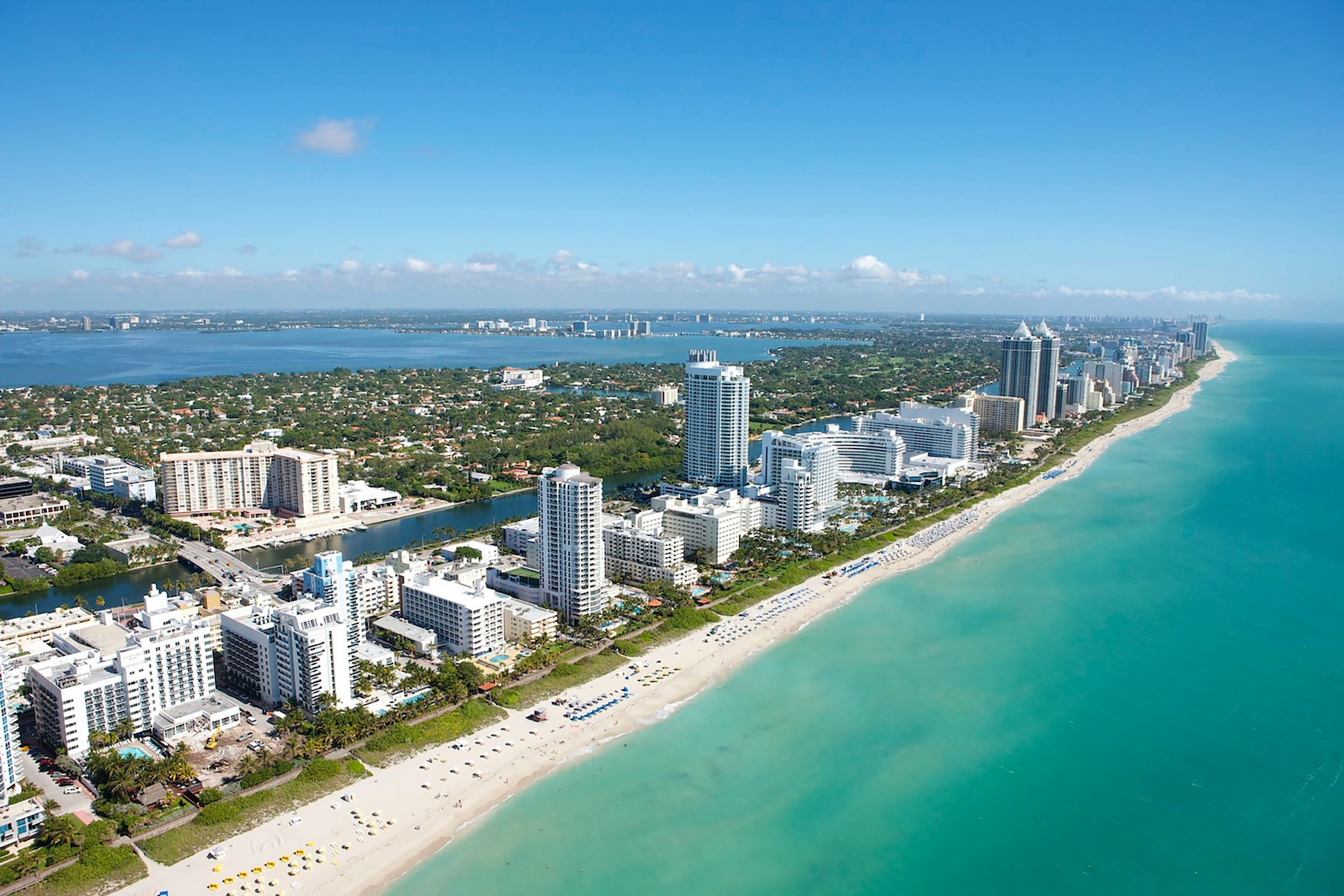
Miami's voters approved the $400 million Forever Bond in 2017, close to half of it earmarked for flood defenses. Repayment comes from property taxes on the city's property base — the same properties those defenses exist to keep dry. Next door, a University of Miami study found tidal flooding in Miami Beach rose more than 400 percent after 2006.
The money protecting the assets is raised against the assets being protected.
The loop
Researchers writing in Nature Cities call this a "climate-debt doom loop." Their concern is a sudden repricing that lands hardest on cities already high-risk and short of money.
Exposure raises the cost of borrowing to defend against the exposure. The communities with the most urgent need to build, and the least room in the budget, are charged the most for building.
The other direction is real too. Muni markets have reflected sea-level-rise exposure in pricing since 2013, according to the Review of Financial Studies, so the most exposed issuers already pay something for it. ICE expected ratings to follow — "likely just a matter of time," in their words.
What a fund can and can't spread
Many of the people who own these bonds own them inside a fund, packed in with hundreds or thousands of others, where any single issuer's exposure disappears into the aggregate.
The packing is deliberate. Spread money across enough issuers and no individual failure can hurt you much. That logic holds when failure is local and idiosyncratic — a budget that doesn't balance, a project that doesn't work, a regional economy that turns. Any one needle is lost in the stack.
Does climate exposure behave that way? My read is that it doesn't. The water is arriving in a great many of these places at the same time. Diversification protects you from bad luck in one place; it can't protect you from one thing happening in all of them.
Both sides of the same bill
There's a version of this closer to home than a fund.
Plenty of households own a home in one state and hold that state's municipal bonds in the brokerage account — often bought for the extra state exemption. Where those bonds are secured by the tax base, the household ends up on both sides of the same mechanism: paying into a tax roll as an owner, and being repaid out of one as a bondholder. Sometimes literally the same one.
Two positions, on two different pages of the statement. One piece of ground.
Sources
- SIFMA, US Municipal Bonds Statistics. $4.5 trillion outstanding as of Q1 2026.
- Intercontinental Exchange, "The U.S. Municipal Bond Market Does Not Price in Physical Climate Risk … Yet," June 2022. Approximately 800,000 municipal bonds, more than $2.5 trillion in outstanding debt.
- City of Miami, Miami Forever Bond. $400 million general obligation bond approved by voters in November 2017; $192 million allocated to sea-level-rise mitigation and flood prevention.
- Wdowinski, Bray, Kirtman and Wu, "Increasing flooding hazard in coastal communities due to rising sea level: Case study of Miami Beach, Florida," Ocean and Coastal Management, vol. 126, June 2016. Tide-induced flooding events rose more than 400% after 2006; data analyzed through 2013.
- Mishra, Arun, Kodra, Smull, Woolcock, Doe, Marlowe and Ganguly, "Physical climate risk creates challenges and opportunities in US municipal finance," Nature Cities, 5 January 2026.
- Goldsmith-Pinkham, Gustafson, Lewis and Schwert, "Sea-Level Rise Exposure and Municipal Bond Yields," Review of Financial Studies, vol. 36 no. 11, November 2023. Pricing began in 2013, coinciding with upward revisions to worst-case sea-level-rise projections.
Figures current as of August 2026.