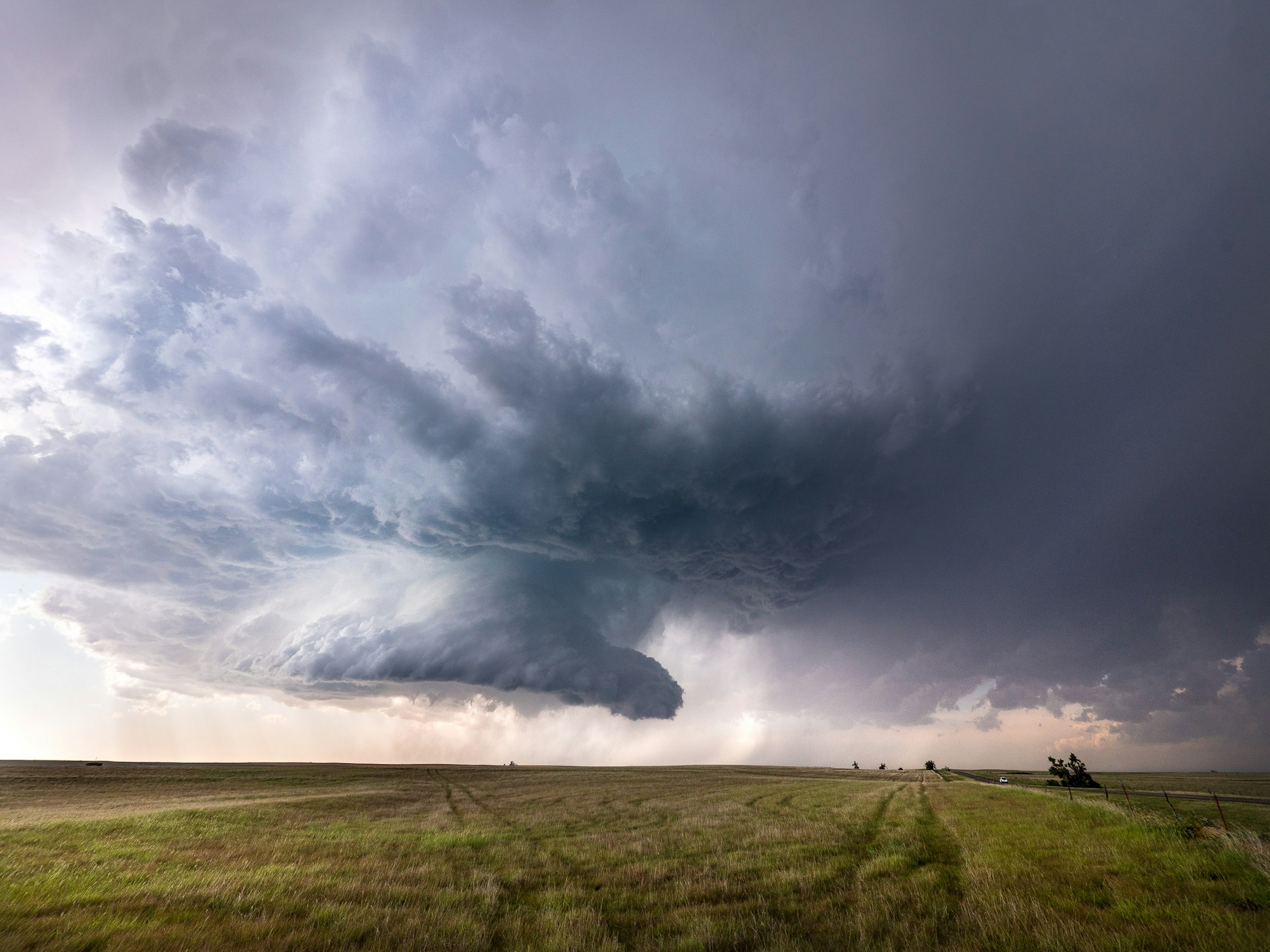
By the insurance broker Aon's count, the storm that has cost insurers the most this century isn't the hurricane. It's the ordinary summer thunderstorm.
What insurers mean by "severe convective storm"
Hail, tornadoes and strong straight-line winds share a single category in the insurance industry: severe convective storms. "Convective" describes how they form, with warm, moist air rising fast into a tall thunderstorm. They're the routine storms of summer on the Plains, without names and rarely on the national news. Each one tends to be local and brief. Added together, they have become enormous.
In its 2026 Climate and Catastrophe Insight report, published in January, Aon said severe convective storms have passed tropical cyclones, the category that includes hurricanes and typhoons, to become the costliest insured peril of the 21st century. In 2025 alone, Aon estimates, they caused about $61 billion in insured losses worldwide. That is the third-highest annual total on record for this peril, driven mostly by outbreaks in the United States.
The year the hurricanes missed
2025 makes the contrast look sharper than it really is. No hurricane made landfall in the United States that year. Aon named the absence of US landfalls as a key factor in the year's numbers. The costliest tropical cyclone of the year, Hurricane Melissa in Jamaica and Cuba, caused about $2.5 billion in insured losses by Aon's estimate.
So any comparison built on 2025 alone flatters the thunderstorm. The century-long ranking is the claim that matters, and it is the one Aon made.
The trend doesn't move in a straight line, either. In its mid-year report, Aon put US severe convective storm losses at about $27 billion for the first half of 2026. That was well below the $40 billion-plus recorded in the first half of each year from 2023 through 2025.
A shift in where losses come from
Swiss Re's research arm sees the same pattern in a different count. In March 2026, it put global insured natural catastrophe losses at about $107 billion for 2025 and attributed a record 92% of that to what it calls secondary perils: severe convective storms, wildfires, floods and other perils that aren't the classic peaks of hurricane and earthquake. Its estimate for severe convective storms alone was about $51 billion. Aon's global total was $127 billion. The two firms measure differently, and estimates like these can disagree by that much. What they agree on is the direction.
The frequency shows up in Aon's event count. In 2025, 30 separate events across all perils each caused more than $1 billion in insured losses, against a historical average of 17. My read is that a peril producing dozens of mid-sized losses a year hits an insurer differently from one that produces a rare giant. It wears down earnings every year, where the rare giant tests capital once a decade, and the cost of that steady wear has to be built into every year's premium.
Looking ahead, Swiss Re projects that if losses return to their long-term trend, global insured catastrophe losses would reach about $148 billion in 2026.
The United States carries most of the cost. Aon put US insured disaster losses at about $103 billion in 2025, or 81% of the global total.
A hailstorm still isn't worse than a hurricane. One large event can outweigh an entire thunderstorm season. The January 2025 Los Angeles wildfires caused about $40 billion in insured losses by Swiss Re's estimate ($41 billion by Aon's), the largest insured wildfire loss on record. The change is in how the losses are spread. Losses that used to come mostly from a few coastal disasters now also arrive in bulk from ordinary storms scattered across the middle of the country.
The map that used to mean cheap
This is how it reaches the cost of a home. My read is that for decades the informal map of disaster risk had two kinds of places on it, the hurricane coast and the fault lines. The Plains, Texas, the Mountain West and the Midwest weren't on that map. Hail counted as weather rather than catastrophe, and insurance there was priced on that basis.
That map no longer matches household budgets. A LendingTree analysis of Census Bureau data, published in July 2026, found that home insurance takes about 8.5% of typical monthly housing costs for homeowners with a mortgage nationally. In Nebraska it takes 19.4%, or about $413 a month. In Oklahoma it's 17.6% and in Texas 14.4%, and LendingTree notes that all three states face severe wind and hail risk. Colorado homeowners with a mortgage pay an estimated $463 a month, with hail and wildfire both cited. LendingTree adds a fair caveat: weather alone doesn't explain rates, and some states with severe weather have lower premiums. These are state-level estimates, not figures for any particular town.
I wrote in Beyond the Coast that inland isn't a synonym for safe, mostly about heat, wildfire and drought. The thunderstorm belongs on that list, and it may be the clearest example of the point.
A disaster with no coastline
The storm Aon now ranks as the costliest insured peril can strike almost anywhere, several times a summer. There's no coastline to draw a line along, no flood zone and no fault. In my view, that makes it harder to price by address and harder to avoid by moving a few miles. Those two features are what made coastal risk legible to buyers in the first place.
In my view, the price follows the losses, with a lag. The places that used to be cheap to insure because they had no "disaster" are now where a large share of the new losses lands.
In Omaha or Denver, summer storms have always come with the territory. What has changed, as I read it, is that they now appear in the insurance premium, and through it, in the cost of owning the house.
Sources
- Aon, "Severe Convective Storms Now the Costliest Insured Peril of the 21st Century, Aon Reports," January 20, 2026 (2026 Climate and Catastrophe Insight). SCS surpassed tropical cyclones as costliest insured peril of the 21st century; $61 billion SCS insured losses in 2025, third-highest on record; global insured losses $127 billion; US insured losses $103 billion, 81% of global; Palisades and Eaton fires $41 billion insured.
- Insurance Journal, "Severe Convective Storms Become Costliest Insured Peril of 21st Century: Aon," January 21, 2026, and Claims Journal, January 22, 2026. Hurricane Melissa about $2.5 billion insured; Aon citing the lack of US hurricane landfalls; 30 insured-loss events above $1 billion in 2025 versus a historical average of 17.
- Aon, H1 2026 Global Catastrophe Recap release, July 22, 2026. US SCS insured losses about $27 billion in H1 2026, versus $40 billion-plus in H1 of 2023–2025.
- Swiss Re Institute, "Wildfires, storms, floods contribute to record 92% of global insured losses in 2025," March 2026 (sigma). Global insured losses $107 billion; secondary perils 92%; Los Angeles wildfires about $40 billion; SCS about $51 billion; no major US hurricane landfall; losses would total about $148 billion in 2026 if they return to the long-term trend. Figures as reported by Artemis, March 19, 2026.
- LendingTree, "Study: Home Insurance and Housing Costs," July 13, 2026. 2024 ACS one-year estimates; homeowners with a mortgage; insurance 8.5% of monthly housing costs nationally; Nebraska 19.4% ($413), Oklahoma 17.6%, Texas 14.4%, Colorado $463/month; wind and hail risk cited; weather alone doesn't explain rates.
Figures current as of October 2026.