On October 7, 2025, Arizona's governor signed a document that cleared the way for as many as 60,000 new homes on the west side of Phoenix. It was not a housing bill, and it was not a zoning change. It was a water designation — the first new hundred-year water approval granted to any provider in the Phoenix metro in 25 years. That the bottleneck for sixty thousand houses was a signature about water tells you most of what you need to know about how this region grows now.
The hundred-year rule
Since Arizona's Groundwater Management Act of 1980, subdivisions in the Phoenix area have carried a condition most buyers never see: before lots can be sold, whoever will serve them has to demonstrate to the state an assured water supply — enough, on paper and in hydrology, to last one hundred years. For decades that proof was easy to make. The aquifer beneath the valley was the evidence, and construction proceeded on top of it.
The model that said no
Then, in June 2023, the state's water regulator published a groundwater model of the Phoenix management area with an uncomfortable bottom line: over the coming century, demand on the aquifer would outrun what it could give by roughly 4.86 million acre-feet. The regulator's response was to stop certifying new subdivisions that leaned on groundwater alone. Note what did and did not happen: the desert did not go dry. What ended was the state's willingness to notarize promises the aquifer might not keep.
Homebuilders sued. In April 2026, a Maricopa County judge threw out the specific rules the water department had written in 2024 to enforce the cutoff, finding the agency had skipped the formal rulemaking process — a procedural defect, and the state says it intends to challenge the decision. The 1980 statute itself was never in question. A hundred years of provable water is still the price of a plat.
Growth did not pause to watch
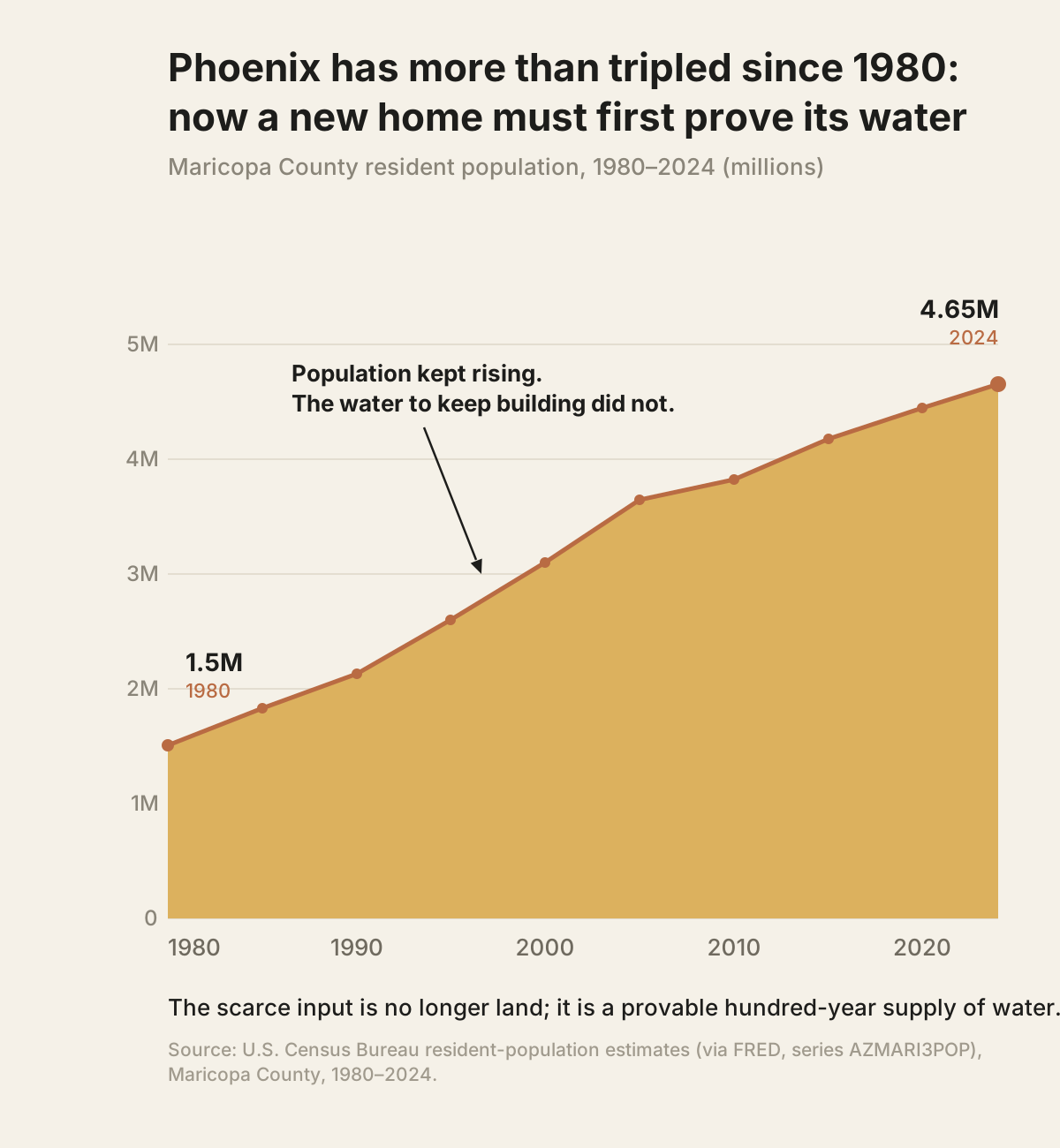
While the lawyers argued, people kept coming. Between July 2023 and July 2024, Maricopa County added 57,471 residents — only Harris County, Texas, and Miami-Dade County, Florida, added more, by the Census Bureau's count. Demand for houses climbing, and a hardening legal limit on where houses may go: that is the squeeze the chart below sits inside.
Water becomes the currency
Which brings back that October signature. The utility, EPCOR, qualified under a new pathway — an alternative designation of assured water supply — by building its hundred-year case on renewable sources: Colorado River allocations and storage at Lake Pleasant layered over groundwater, with mandatory cuts to its aquifer pumping as part of the deal.
The legislature opened a second pathway in 2025. Under the "Ag-to-Urban" law signed that June, a builder can acquire irrigated farmland, permanently retire its groundwater pumping, and convert the retired water into credits that count toward the hundred-year proof for new homes nearby. Think about what that transaction actually is: the farm is incidental. The purchase is the water. An acre-foot that once grew alfalfa can be worth more holding up rooftops.
The question under the address
For anyone weighing a market for a long hold, this adds a question that a listing will not answer: what supply stands behind this address for the next century, and what is it made of? A subdivision anchored to renewable water under a current designation is a different asset from one drawing on an aquifer the state has already modeled as oversubscribed — even when the two look identical from the street.
My read: Phoenix is not going to stop growing — the population curve shows no such intention. What has changed is the direction of growth. It now flows toward whoever can prove the water, and land that arrives with a demonstrated century of supply is separating in value from land next door that cannot make the same showing.
The lot was never the scarce part. The century of water underneath it is.
Sources
- Arizona Department of Water Resources, Phoenix AMA Groundwater Supply Updates. June 2023 groundwater model: ~4.86 million acre-feet of unmet demand over 100 years; pause on new determinations of assured water supply relying on groundwater.
- Office of the Arizona Governor, "Governor Katie Hobbs Celebrates Historic Water Milestone as EPCOR Receives Designation for 100-year Assured Water Supply," October 2025. First assured-water-supply designation in the Phoenix AMA in 25 years; up to 60,000 homes; see also ADWR on the ADAWS program, October 8, 2025 (renewable supplies with required groundwater-pumping reductions).
- U.S. Census Bureau, Vintage 2024 county population estimates, March 13, 2025. Maricopa County +57,471 residents July 2023–July 2024, third-largest numeric gain among U.S. counties (behind Harris County, TX and Miami-Dade County, FL).
- Arizona SB1611 (2025), the "Ag-to-Urban" law; signed June 2025, effective September 26, 2025. Irrigated farmland's groundwater rights can be permanently retired for credits toward the Assured Water Supply program's physical-availability requirement; see ADWR's Ag-to-Urban program page.
- KJZZ, "Arizona water agency rules that restricted homebuilding were illegal, judge rules," April 22, 2026. Maricopa County Superior Court voided ADWR's 2024 unmet-demand and depth-to-water rules on procedural grounds; ADWR intends to challenge; the underlying 100-year assured-supply requirement is unaffected.
- Federal Reserve Bank of St. Louis (FRED), Resident Population in Maricopa County, AZ, series AZMARI3POP, 1980–2024 (chart data).
Figures current as of September 2026.