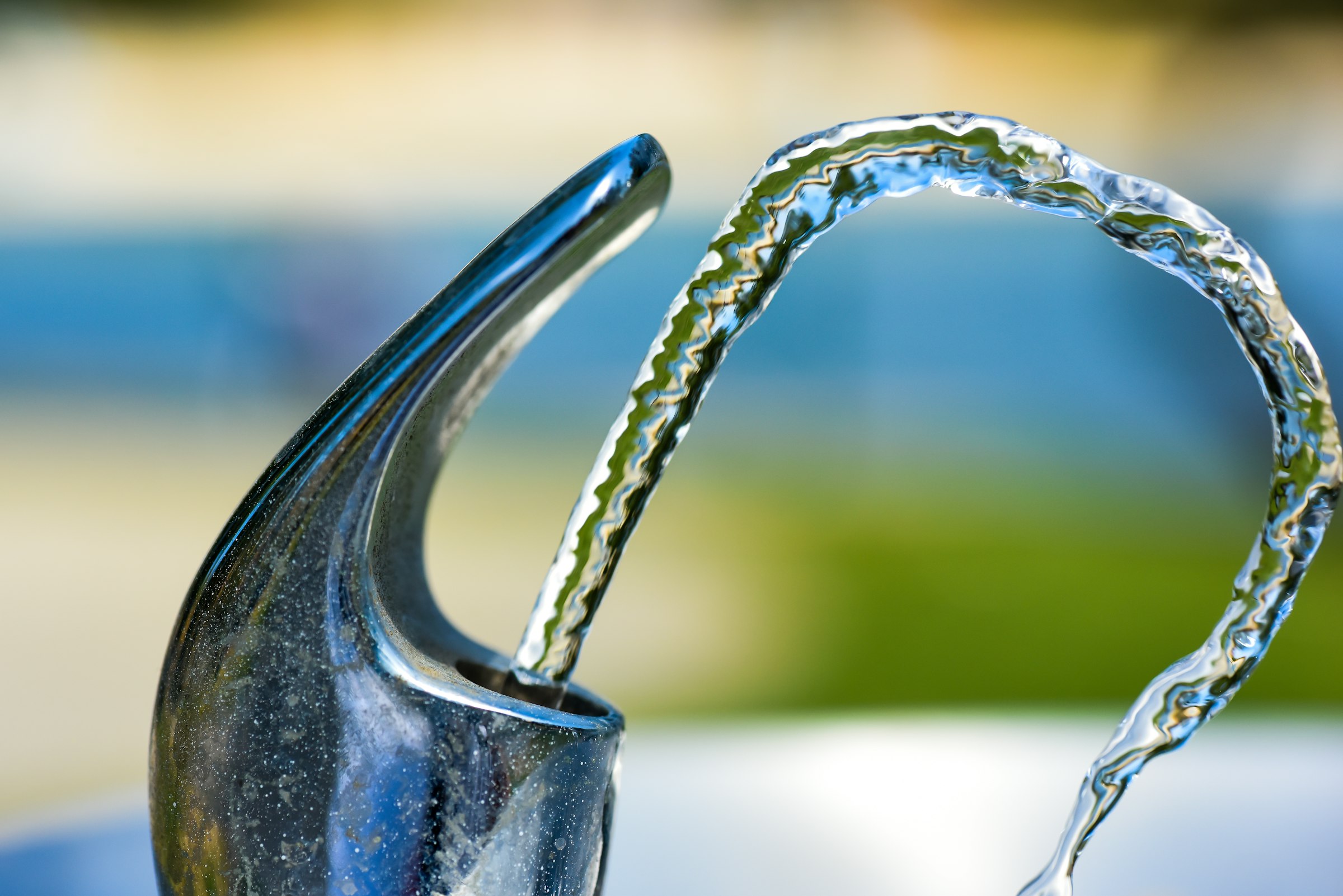
Orange County has been turning wastewater into drinking water since 2008. And not a small amount of it, either.
Since its final expansion was completed in 2023, the county's Groundwater Replenishment System has had capacity to purify up to 130 million gallons a day. That's enough for about a million people, according to the Orange County Water District, which runs it. I only learned about it recently. The more I read, the more interesting it got, both the engineering and the economics.
How it works
The process starts with sewage that the Orange County Sanitation District has already treated. Before the system existed, much of that water was released into the Pacific. Now it goes through three more steps: microfiltration, reverse osmosis, and ultraviolet light combined with hydrogen peroxide. The advanced treatment takes about 45 minutes, the water district says.
The purified water doesn't go straight into anyone's tap. About 30 million gallons a day is injected along the coast to form a barrier that keeps seawater from seeping into the aquifer. Most of the rest goes into recharge basins in Anaheim, where it soaks down through sand and gravel into the groundwater basin. It stays underground for roughly six months before local water agencies pump it back up as part of their regular supply. Engineers call this indirect potable reuse. The aquifer sits between the treatment plant and the tap.
The system has grown in stages: 70 million gallons a day when it opened in 2008, 100 million after a first expansion in 2015, and 130 million after the final one in 2023. In 2022 it began taking wastewater from a second sanitation plant as well, which let the two districts recycle all of the wastewater flow suitable for reuse, according to the project team.
Why it matters for supply
The groundwater basin under north and central Orange County is the main drinking-water source for more than 2.5 million people. The 19 cities and water agencies that draw on it can pump about 85 percent of their demand from the basin, according to the water district. The other 15 percent is imported, from the Colorado River and from Northern California through the State Water Project.
The recycled water is a large share of what keeps that basin full. In a 2024 case study, the U.S. Environmental Protection Agency said the system provides up to one-third of the water put into the basin each year.
What I find clever is that the new supply comes from water the county has already used once. That reduces how much it has to import, though it doesn't end imports.
The engineering that cost less
The final expansion is also a case study in spending less, at least by its builders' account.
To bring wastewater from the second sanitation plant, three miles away in Huntington Beach, the expansion needed a pipeline. Instead of trenching a new one through a narrow right-of-way, the team reused a 66-inch overflow line built in 1957 that was rarely used. They relined it with fiberglass-reinforced plastic and converted it from a gravity line to a pressure line. They expect the larger pipe and new lining to save about $200,000 a year in energy.
They also tested before buying. The original plan was to keep using the same kind of microfiltration membranes, but those wouldn't fit well in the space available. So water district staff installed two newer types at full scale and collected data for more than six months. Only then did they put the membranes out for competitive bids. "The testing and selection process saved the district $8 million over what was budgeted," according to the project team's April 2025 account in Journal AWWA.
That account comes with a caveat a reader should know about. Its authors are two executives from Black & Veatch, the engineering firm on the project, plus senior leaders of the water and sanitation districts. Journal AWWA is the American Water Works Association's professional journal, but the savings are the team reporting on its own work, not an independent audit. Some of the other savings it describes are projections. For example, the team expects a pump redesign in the reverse-osmosis system to save more than $10 million in energy over the equipment's life.
What it costs
Even taken at face value, the savings are small next to the totals.
The final expansion cost $284 million, according to the water district. Across the original plant and both expansions, construction costs have been more than $900 million. The state helped finance a lot of it. California's State Water Resources Control Board says it provided $491 million over 17 years, more than 54 percent of the system's capital costs. Nearly all of that, $481 million, came as low-interest loans, mostly from the Clean Water State Revolving Fund, plus $10 million in grants.
Then there's running it. Reverse osmosis pushes water through membranes at high pressure, which uses a lot of energy, and the plant runs year-round. The EPA's case study says the expansion adds supply "at a lower cost than imported water." Whether that holds up depends on what you count, including the loan terms, the subsidies, and the sanitation district's share of treatment. I haven't seen an independent full-cost comparison, so I'm not making one here.
Two more caveats. The 130 million gallons is daily capacity, not a promise of daily output. And the $8 million saved on membranes doesn't automatically mean lower water bills. It means that part of the expansion came in under its own budget.
A different way to think about scarcity
Water scarcity is usually framed as a problem of finding more water somewhere else and moving it here. Much of Southern California's supply still arrives that way, from the Colorado River and from Northern California. In The House Was Never the Scarce Part I wrote about Phoenix, where new homes now depend on proving a century of supply. Supply is the constraint everyone is watching.
Orange County has put more than $900 million into a different answer: getting more use out of the water it already has. It still needs imports, and it pays for this supply in energy and debt. But a large share of what its residents drink now comes from water that was used once already, cleaned, and returned to the ground, rather than from water piped in from somewhere else.
Sources
- Orange County Water District, Groundwater Replenishment System FAQ. Online January 2008 at 70 mgd; 100 mgd (2015); 130 mgd (2023), enough for about one million people; microfiltration, reverse osmosis, UV with hydrogen peroxide (about 45 minutes); about 30 mgd to the seawater barrier, the rest mostly to Anaheim recharge basins; about six months underground; construction costs about $481M initial, $142M first expansion, $284M final, over $900M total.
- California State Water Resources Control Board, press release on completion of the final expansion, April 14, 2023. 130 mgd; about one million residents; $491 million over 17 years (more than 54% of capital costs): $481 million in low-interest loans, primarily Clean Water State Revolving Fund, and $10 million in grants.
- James H. Clark, Jeff Neemann, Mehul Patel and Robert Thompson, "Final Expansion of California's Celebrated Groundwater Replenishment Project," Journal AWWA, April 2025 (doi:10.1002/awwa.2419). Relined 1957 66-inch, 3-mile line (projected ~$200,000/yr energy savings); six-month full-scale membrane testing and competitive bid saved $8 million against budget; interstage boosting projected to save more than $10 million in energy over equipment life; Plant No. 2 flows from 2022; basin primary supply for more than 2.5 million people. Authors are from Black & Veatch, OCWD and OC San.
- Orange County Water District, "How water works in Orange County." About 2.5 million residents served; north and central Orange County agencies pump about 85% of demand from the basin; 15% imported from the Colorado River and State Water Project.
- U.S. Environmental Protection Agency, Clean Water State Revolving Fund case study: OCWD Groundwater Replenishment System final expansion, 2024. About $182 million CWSRF loan; GWRS water up to one-third of annual basin inflow; supply "at a lower cost than imported water."
Figures current as of October 2026.