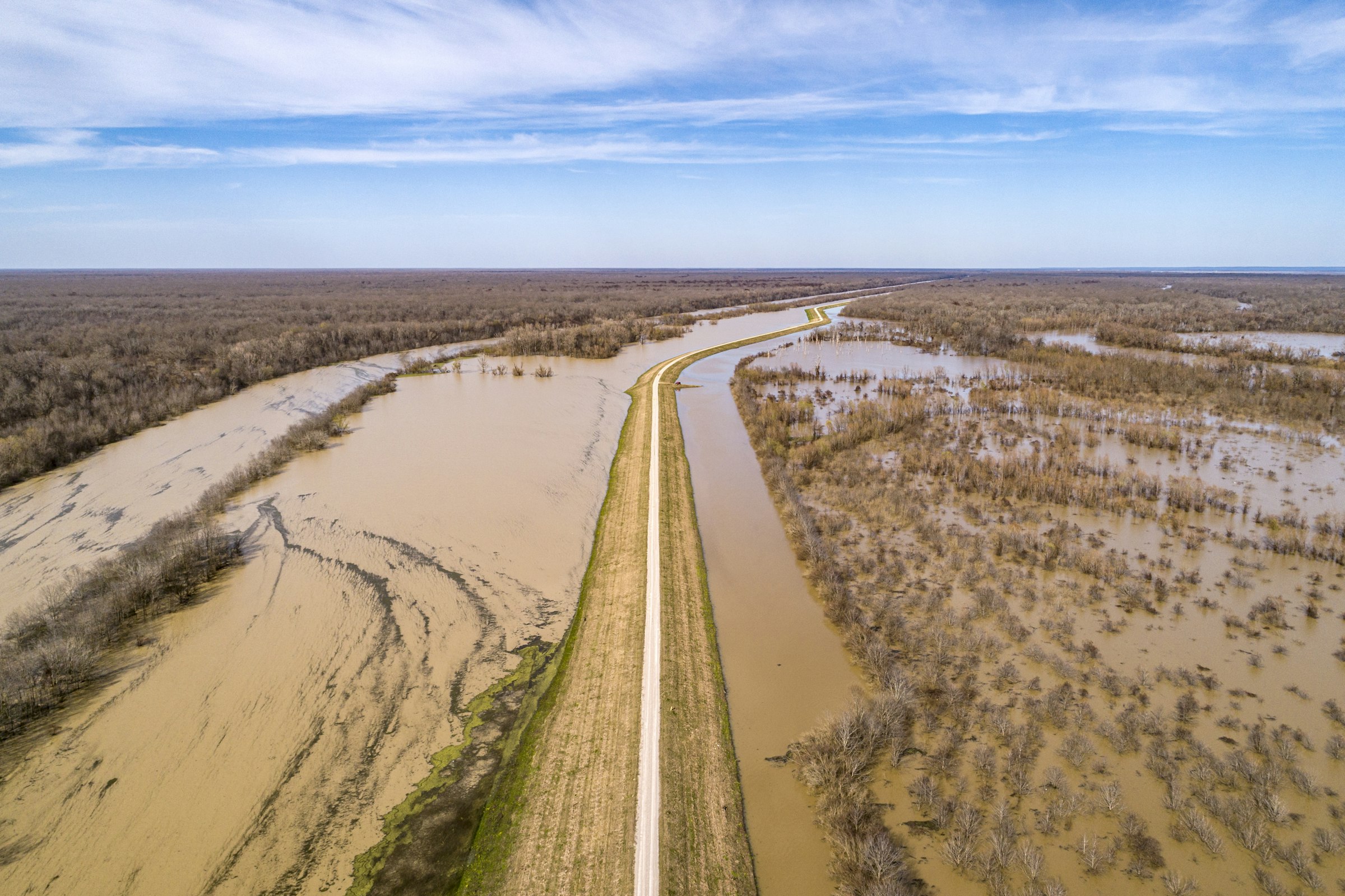
Ask who loses money when a mortgaged house floods in the twelfth year of a thirty-year loan, and the natural guess — the bank that wrote the loan — is almost always wrong. The bank sold that loan within weeks of closing. By the time the water arrives, the risk has moved.
Where it moved is the point of this post. Most American home loans are sold soon after origination to Fannie Mae and Freddie Mac, the two government-chartered mortgage companies, whose guarantees cover roughly half of the country's single-family mortgage debt. Their guarantees are not formally guarantees of the United States — but both companies have operated under federal conservatorship since 2008, with the Treasury committed to keeping them solvent. In practice, the risk that leaves the bank comes to rest with the public.
The fee that doesn't ask about water
When Fannie or Freddie guarantees a loan, it charges a fee for taking the credit risk. That fee varies with the borrower's credit score and down payment. It does not vary with the property's flood exposure. A loan against a floodway property pays the same guarantee fee as one against a home on high ground — which is why the Congressional Budget Office counts expected flood damage as a subsidy: the guarantee absorbs a cost it never charges for.
The CBO has estimated what that silence costs: flood damage added an estimated $275 million to the subsidy cost of the mortgages the federal government backed in fiscal year 2024, with loans guaranteed by Fannie and Freddie bearing a larger share of the damage than other federal programs. Under the climate conditions projected for 2053, the CBO puts the figure at about $395 million. The exposure is heavily concentrated — the riskiest quarter of census tracts accounts for about ninety percent of the total.
The losses arrive through two doors. One is damage. The other is default: flooded owners sometimes stop paying. Working from loan-level records the guarantee companies themselves keep, researchers at the Federal Reserve Bank of Richmond measured what Hurricane Irma did to mortgages in the ZIP codes the storm hit hardest and found the default rate rose about 0.4 percentage points across the six quarters that followed — small per loan, meaningful across a guarantee book measured in trillions.
The households holding the thin end
Whoever eventually pays, the disruption starts with the borrower — and the borrowers most exposed are the least padded. An analysis the Consumer Financial Protection Bureau published in January 2025 found some 440,000 homes with mortgages likely underinsured against flood in the two regions it examined, the Southeast and the central Southwest — and found that the borrowers in the inland flood-prone areas tend to bring smaller down payments, weaker credit, and less income to the table than their coastal counterparts. The coastal owners in the study more often carried adequate coverage and the means to recover. The inland owners, clustered near rivers and streams, more often carried neither.
The regulator that oversees Fannie and Freddie has said the quiet part in writing. In December 2024, the Federal Housing Finance Agency described its work to close "data and methodology gaps" in climate scenario analysis so that the two companies "will be able to quantify the losses caused by extreme climate events at the property level" — a goal whose grammar concedes the present: they cannot yet. The scenario analyses run so far have been exploratory. And the taxpayer's stake in whatever those tools eventually find follows from the guarantee itself.
What this means if the house is yours
I wrote in The Cost of an Honest Premium about what happened when federal flood insurance started telling each home the truth about its own risk: premiums moved, and some owners walked away from coverage. The mortgage system has not had its honesty moment. The thirty-year fixed rate on a flood-exposed home is priced today as if the coming three decades of weather will resemble the three behind us, because the guarantee behind it charges nothing for the difference.
For an owner or a buyer, that has two practical readings. The comfortable one: cheap, stable credit is currently available on properties whose flood risk the lending system does not price, and that credit supports today's values. The uncomfortable one: a subsidy that exists because nobody has measured it yet is not a permanent feature of the landscape. The FHFA is building the measurement tools. If guarantee pricing ever starts to vary with flood exposure, credit on the most exposed homes gets more expensive, and values that rest on cheap credit would have to adjust.
None of that is a prediction with a date on it. It is a description of which way the risk points. The insurance market has already repriced; the mortgage market has not; and a homeowner reading the mortgage market's silence as reassurance is reading it backwards. The rate is quiet because the risk was moved — not because it was measured and found small. It sits where it has sat all along: under the house.
Sources
- Urban Institute, Housing Finance Policy Center, "Housing Finance at a Glance" chartbooks. Fannie Mae and Freddie Mac's combined single-family guarantee book relative to total US single-family mortgage debt (roughly half); see also Federal Reserve Financial Accounts (Z.1) and the companies' Form 10-K filings.
- Congressional Budget Office, "The Effects of Flood Damage on the Subsidy Cost of Federally Backed Mortgages," Working Paper 2024-04, July 2024. Flood damage added an estimated $275 million (2.9% of the total) to the subsidy cost of federally backed mortgages originated in fiscal year 2024, rising to about $395 million under climate conditions projected for 2053; the riskiest 25% of census tracts account for about 90% of the total; mortgages guaranteed by Fannie Mae and Freddie Mac incur a larger cost than other federal programs.
- Federal Reserve Bank of Richmond, "How Do Natural Disasters Affect Mortgage Delinquency?" Economic Brief 24-22, July 2024. Hurricane Irma raised mortgage default frequency in affected ZIP codes by about 0.40 percentage points over six quarters, in GSE loan-level data.
- Consumer Financial Protection Bureau, "Flood Risk and the U.S. Mortgage Market," January 13, 2025. Roughly 440,000 mortgaged properties in the Southeast and central Southwest potentially underinsured against flood; inland flood-area borrowers show lower incomes, lower credit scores, and smaller down payments than coastal ones. See also the bureau's announcement.
- Federal Housing Finance Agency, "An Overview of FHFA's Key Initiatives to Address Climate-Related Financial Risks," December 20, 2024. Quoted language on closing "data and methodology gaps" in climate scenario analysis so the Enterprises "will be able to quantify the losses caused by extreme climate events at the property level"; exploratory scenario analyses to date.
Figures current as of September 2026.